

Notes

Writing and research — essays on instructional engineering and learning systems, and peer-reviewed work in sustainability science.

Richard Feynman lecturing at a chalkboard of equations and Feynman diagrams, cropped low-profile; added chalk text reads: Less (conceptual) over-simplification! More (learner) sophistication!
Adapted from Richard Feynman lecturing at blackboard [Photograph], 1964, Caltech Images Collection (Item 1.10-5), Caltech Archives and Special Collections, California Institute of Technology (https://library.caltech.edu/archives). Cropped, with text and image additions; use permission requested.

Engineered Training Design

The through-line under all of this: instruction treated as an engineered system — analyzed before it is built, specified before it ships, and checkable at every step. The essay traces where that idea comes from — the theorists, sciences, and crafts that converge on it — and how it runs through the work on this site.

Instructional & Learning Systems

Essays on instructional engineering, learning experience design, and the evidence discipline behind them. Published on Medium; synopses below link to each full essay.

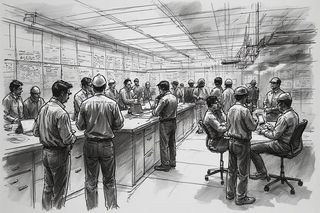
Pencil-sketch illustration of a technical operations room: workers in hard hats at benches with laptops and tablets, the walls covered in posted documents and diagrams.

Log N-05 · 2025-11-02 · Medium

Instructional engineering in practice — orchestrating mobile technology implementation in complex environments

Dewey's "education as engineering" applied to a mobile-technology rollout in a fictional national-laboratory setting: constraints as the shape of the problem, three families of tension, and the governance layer — NIST, Section 508, WCAG — that makes an implementation hold.

Read on Medium ↗


Chalkboard-style schematic of a human head in profile with the brain exposed, surrounded by technical annotations and callout lines.

Log N-04 · 2025-10-27 · Medium

Is it time to learn how to design LX for extended reality that communicates with the human nervous system?

XR learning experiences that answer to the nervous system: a best-practices checklist spanning cognitive efficiency, physiological integrity, ethical data, and mastery.

Read on Medium ↗
Screenshot of a force-directed network graph: clusters of hundreds of nodes radiating from hub points on a dark canvas, titled CS-PLN.

Log N-03 · 2025-10-20 · Medium

The mechanics and structure of modern learning

A personal learning network treated as a measurable socio-technical system — the force-directed graph as a diagnostic instrument, with centrality and modularity as predictors of performance.

Read on Medium ↗
Pencil sketch of two apples drawn on the screen of a smartphone lying on graph paper.

Log N-02 · 2025-10-16 · Medium

Microlearning vs cognitive nuance

Efficiency versus fidelity as a constrained-optimization problem: Hug's definition of microlearning, system archetypes, and Pareto-optimal essentialism in course design.

Read on Medium ↗
Pencil drawing of a laptop displaying charts and documents beside an open laboratory notebook with plots and a pen.

Log N-01 · 2025-10-06 · Medium

Web logs and lab notebooks: cognitive prostheses to improve technical comprehension

The extended-mind thesis meets the laboratory notebook: writing as a cognitive prosthesis, problem→model→evidence→transfer templates, and xAPI instrumentation for technical comprehension.

Read on Medium ↗

All essays are hosted on Medium — medium.com/@cs.lxe.io ↗

Sustainability & Social Conscience

Two peer-reviewed studies in agricultural sustainability, co-authored during graduate research. They sit here for a reason that carries into the instructional work: sustainability — environmental, social, and economic — is a design constraint I account for in the training I build and in the resources spent to build it. Downstream effects are the point. Cleaning a river means cleaning the small tributaries that feed it, and the same logic governs how I treat accessibility and quality, whose consequences reach well past the target learner. The focus on perennial forages is deliberate. Livestock feed is one of agriculture's largest single claims on land, water, and emissions, and agriculture in turn drives a large share of humanity's environmental footprint (Foley et al., 2011 ↗); perennial forage systems are among the more tractable levers for reducing it. The invitation is cross-disciplinary: a designer who can read and validate the science need not treat every subject-matter expert as a black box.

Cover of the journal Weed Science, volume 74, published by Cambridge University Press.

Eckert, K., Stamplis, C., Hur, J., Bell, T., Couradeau, E., Crandall, S., Larson, E., & Lowry, C. J. (2026). Influence of perennial forage communities on weed seed mortality and seed microbial associations. Weed Science, 74, Article e42. https://doi.org/10.1017/wsc.2026.10116 ↗

Do living perennial forages change which weeds survive in the soil seedbank — and the microbes those seeds carry? Buried-seed trials of alfalfa, orchardgrass, and chicory (alone and in mixtures) tracked weed-seed mortality and sequenced the seeds' bacterial and fungal communities: a step toward weed management that leans on ecology rather than chemistry.

Read article ↗ Open access · CC BY 4.0

Cover of the journal Ecosphere, volume 15, number 6, June 2024, published by the Ecological Society of America, showing a river winding through a red-rock canyon.

Isaacson, A., Contosta, A., Smith, R. G., Stamplis, C., & Lowry, C. J. (2024). Effect of increasing temperature and temperature fluctuations on alfalfa and orchardgrass in the establishment year. Ecosphere, 15(6), Article e4905. https://doi.org/10.1002/ecs2.4905 ↗

How does a warmer, more erratic climate hit a forage stand in its vulnerable first year? Field open-top chambers imposed constant and fluctuating warming on an alfalfa–orchardgrass mixture, measuring frost injury, weed pressure, and yield — evidence for forage management that holds up as the climate shifts.

Read article ↗ Open access · CC BY 4.0